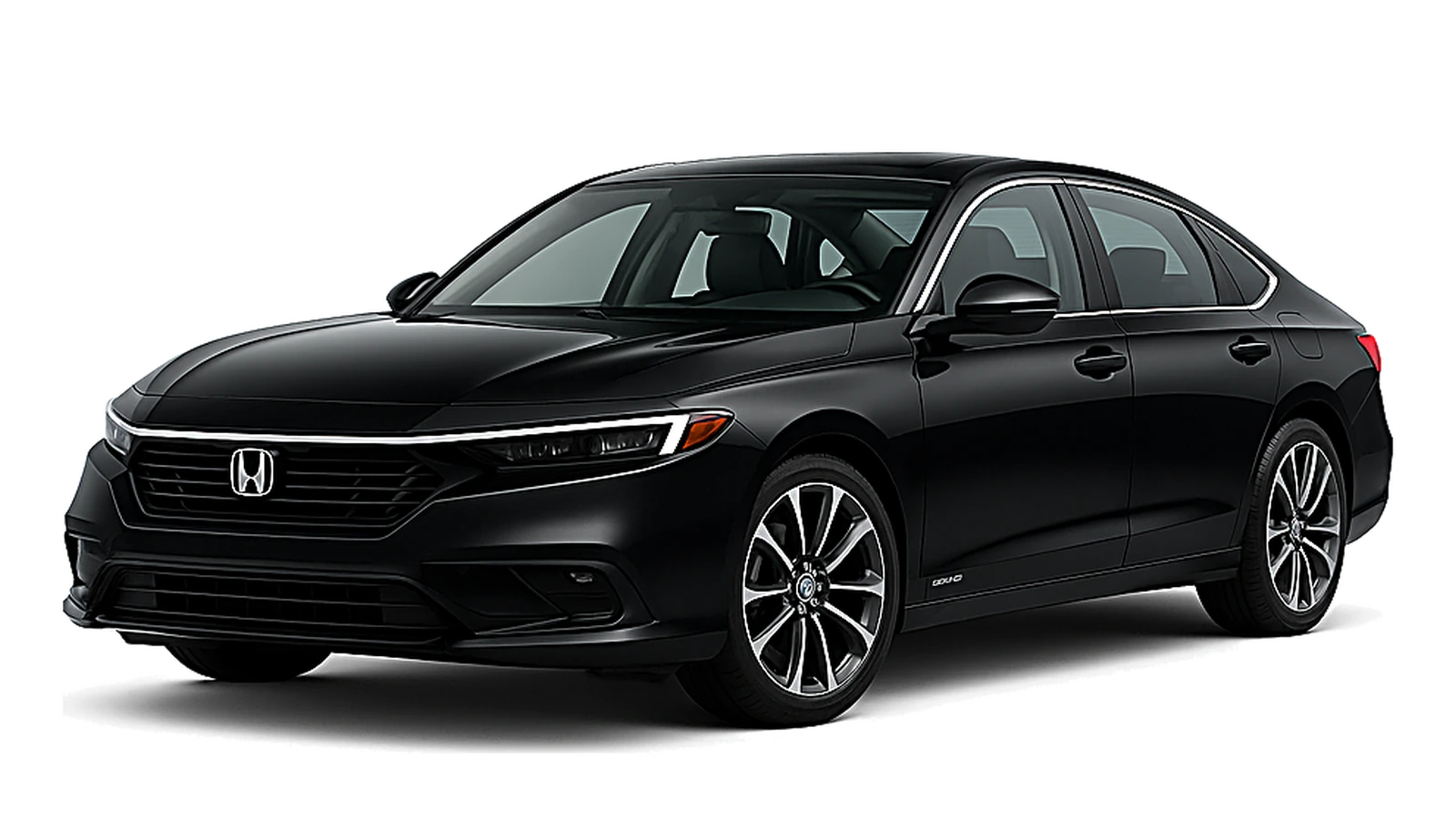
Is the 2026 Honda Accord Touring Worth Its $11,100 Premium Over the LX?
The numbers say the top Accord trim costs more without delivering more efficiency — the EX-L actually beats it on EPA figures for $4,400 less.
By IFMG Editorial
2026 Accord Buyers Are Saving an Average of $2,500 This Way
Stop guessing what a fair price is. See the invoice price on the exact Accord you want, then let 3 local dealers compete for your business.
Get Local OffersThe Math at the Top of the Lineup
The Touring sits at the top of the Accord range at $39,495, which is $11,100 more than the LX ($28,395), $8,800 more than the SE ($30,695), $5,700 more than the Sport ($33,795), and $4,000 more than the Sport-L ($35,495). That last gap matters most: Sport-L and Touring share identical drivetrain hardware — a two-motor hybrid system, electronic CVT, front-wheel drive, 16.7 cu.ft. of cargo room, five-passenger seating — and identical EPA ratings of 46 city, 41 highway, 44 combined. Paying $4,000 more for the same mechanical spec sheet is not a small ask.
Where the Premium Actually Loses Ground
Compare Touring to the EX-L and the case gets worse, not better. The EX-L costs $35,095 — $4,400 less than Touring — yet posts EPA numbers of 51 city, 44 highway, 48 combined. That is a real edge in every category, not a rounding error. On paper, a buyer who picks Touring over EX-L pays more money for a car that burns more fuel over the same distance. Nothing else in the published spec sheet — warranty terms, cargo volume, seating, transmission type — differs between the two trims. Warranty coverage across the whole Accord lineup is identical: 3-year/36,000-mile basic, 5-year/60,000-mile powertrain, 5-year/unlimited-mile rust-through, and one year of complimentary maintenance. The deltas here are sticker price and MPG, and Touring loses on both to a cheaper trim.
2026 Accord Buyers Are Saving an Average of $2,500 This Way
Stop guessing what a fair price is. See the invoice price on the exact Accord you want, then let 3 local dealers compete for your business.
Get Local OffersWhat the Data Can't Tell Us
This comparison rests on mechanical specs and pricing, not a full feature-by-feature equipment list. Touring likely carries additional content — the badge name and price gap suggest it — but that isn't part of the verified data here, so it can't be assumed or scored. What can be said with confidence: none of the measurable performance or efficiency numbers favor Touring over EX-L or Sport-L. A buyer weighing this trim should get an actual feature list from a dealer before paying $4,000 to $4,400 more for a car that, spec for spec, doesn't outperform cheaper options in the same lineup.
The Smart Value Pick
On the numbers alone, the EX-L is the strongest hybrid buy in this lineup. It costs $6,700 more than the LX and $4,400 more than the SE, but it delivers the best EPA figures of any Accord trim — 51 city, 44 highway, 48 combined — while sitting $4,400 below Touring and $400 below Sport-L. For buyers cross-shopping hybrids specifically, the related coverage on the Accord Sport-L's value case and the Accord EX-L review both work through similar trade-offs from different starting points in the lineup.
Where Touring Fits, If at All
Touring isn't a bad car by any measure in the data — it shares the same efficient two-motor hybrid powertrain as three other trims and the same cargo and seating specs as the entire lineup. But 'worth it' is a relative question, and relative to EX-L and Sport-L, Touring's extra cost buys no measurable gain in efficiency or capacity per the published specs. Anyone drawn to Touring specifically for design or trim-exclusive equipment not covered in this spec set should verify that content directly, since the numbers alone don't justify the step up.
By the Numbers
Frequently Asked Questions
Not based on the published numbers. Touring costs $4,400 more than EX-L but returns lower EPA figures (46/41/44 vs 51/44/48), with no other spec differences documented between the two.
The hybrid premium is $5,400 — the cost of the Sport ($33,795) over the gas LX ($28,395) — and buys a jump from 32 combined MPG on the LX to 44 combined MPG on the Sport, a substantial efficiency gain for the added cost.
The EX-L leads the lineup at 51 city, 44 highway, 48 combined MPG, ahead of the Sport, Sport-L, and Touring, which all share 46/41/44 MPG ratings despite different price points.
The EX-L stands out because it posts the best fuel economy of any trim while costing $4,400 less than Touring and only $400 more than Sport-L, which shares Touring's lower MPG ratings.
No. Both use the same two-motor hybrid-electric powertrain, electronic CVT, and front-wheel drive layout, with identical EPA ratings across city, highway, and combined MPG.
Touring costs $5,700 more than Sport (16.9%) with identical EPA ratings and the same core hybrid powertrain, so the added cost isn't justified by anything in the published specs.
Bottom Line
The 2026 Accord Touring costs more than every other trim in the lineup but doesn't deliver better fuel economy than the EX-L, which undercuts it by $4,400. Spec for spec, Touring's premium isn't backed by the numbers.
You've confirmed Touring-exclusive equipment or design elements outside this spec set that justify the cost to you personally.
You're shopping primarily on efficiency or value — the EX-L delivers better MPG for thousands less.
No urgency either way; the pricing and spec gaps here are structural to the trim lineup, not tied to any timing or incentive window in the available data.
2026 Accord Buyers Are Saving an Average of $2,500 This Way
Stop guessing what a fair price is. See the invoice price on the exact Accord you want, then let 3 local dealers compete for your business.
Get Local OffersNext steps
- Buyer's Guide
- Inventory
- News
- Recalls
- Compare
- Reviews
- Trim details
- 2026 Honda Accord vs Toyota Camry: Hybrid MPG, AWD, and the Trim Choice That Matters
- 2026 Honda Accord vs Nissan Altima: Hybrid MPG or AWD Gas Sedan?
- 2026 Honda Accord vs Kia K5: Hybrid MPG or Gas Simplicity?
- 2026 Honda Accord vs Hyundai Sonata: Hybrid MPG or Conventional Gas?